

Heat accounts for more than 70% of the energy consumed by industry and continues to be generated largely from fossil fuels across the European Union. Decarbonising industrial heat is therefore not only an environmental imperative, but also a matter of resilience—regarding the availability of energy resources—and competitiveness—regarding their cost—for European industry in an uncertain international environment.
Against this backdrop, the European Union is strengthening its support for decarbonised industrial heat with the launch of a new edition of the Heat Auction, expected in December 2026 with a budget of €1 billion. In France, the Heat Fund and France 2030 schemes complement this initiative by providing industry with significant funding opportunities.
Heat Auction: an auction mechanism based on carbon performance
On 24 September 2026, the European Commission published the final terms and conditions of the second Heat Auction, which is expected to open in December 2026. Implemented under the Innovation Fund, the auction is expected to have a planned budget of €1 billion to support decarbonised heat production projects.
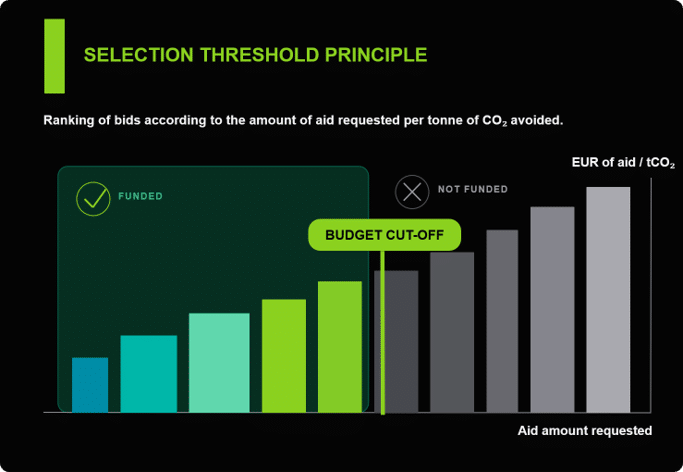
The scheme places projects in competition according to the level of support requested. Each applicant will propose a premium expressed in euros per tonne of direct CO₂ emissions avoided. Bids will be ranked from lowest to highest and selected in that order until the available budget is exhausted. Under the pay-as-bid principle, each successful bidder will receive the premium proposed in its bid, based on verified emission reductions and for a maximum period of five years.
Potentially more attractive support
Depending on the project’s economic characteristics and the premium requested, this mechanism may offer a higher level of support than certain national schemes, whose aid intensities and ceilings are governed by European State aid rules.
However, the competitiveness of the bid remains decisive: a higher premium may better cover the funding requirement but may reduce the likelihood of selection. Applicants will therefore need to set their bid price as close as possible to their actual funding need, balancing economic viability and competitiveness.
Encouraging results from the first auction
The first auction confirmed the attractiveness of the scheme: 65 of the 85 applications received were selected, representing a ratio of approximately 76%. With capacities ranging from 3 to 45 MWth and funding requests ranging from €444,000 to €37.1 million, the results demonstrate the Heat Auction’s ability to support a wide variety of projects, from medium-sized operations to major industrial investments.
A broader scope
The final terms and conditions provide that the second auction will be open to all industrial sectors across the European Economic Area. Depending on the temperature category, projects will need to meet a minimum thermal capacity of 3 or 5 MWth and incur at least €2.5 million in capital expenditure.
The scheme will cover electrification technologies such as heat pumps, electric boilers, plasma torches and thermal storage, as well as the direct production of renewable heat from solar thermal energy or geothermal energy. For the first time, certain nuclear technologies, including small modular reactors, will also be eligible.
The second auction will also encourage flexibility solutions that reduce electricity consumption during peak periods through a ranking bonus.
The Heat Fund remains a cornerstone national scheme
This new European opportunity does not diminish the central role of the French Heat Fund. Operated by ADEME since 2009, the scheme supports the replacement of fossil-fuel installations with renewable or recovered heat and cooling production equipment.
It supports projects based in particular on biomass, geothermal energy, solar thermal energy, biogas or recovered energy, as well as their integration into heating or cooling networks. The scheme may provide support from the study phase through to the implementation of investments.
In 2025, the Heat Fund provided €801 million in support to projects, with an average cost-effectiveness of €51.5 in aid per tonne of CO₂ emissions avoided. It is one of the most effective instruments for decarbonising the economy and reducing gas imports. Although the continuation of the scheme is not in question, its budget is currently under discussion as part of the 2027 Finance Bill. A €300 million reduction is being considered, but it remains subject to parliamentary scrutiny and approval. If confirmed, the reduction could make the Heat Fund more selective and increase the importance of preparing projects sufficiently early and to a high standard.
France 2030 calls for projects: complementary levers for decarbonising industrial heat
Alongside the Heat Fund, France 2030 calls for projects have been launched to support investments contributing to the decarbonisation of industrial heat. DECARB IND targets major projects involving more than €3 million in investment (the call is currently closed), while DECARB FLASH covers projects with investment costs ranging from €100,000 to €3 million, primarily undertaken by SME industrial sites or by sites operated by large companies that are not subject to the EU ETS (open until February 2027). These schemes may notably finance energy-efficiency, waste-heat recovery and energy-mix transformation projects.
The Major Industrial Decarbonisation Projects call for tenders (“GPID”) aims to support large-scale decarbonisation projects in the chemicals, non-metallic materials, equipment and goods, metals, petrochemicals and agri-food sectors, providing an average of more than 200 m€ in support per project over 15 years. With a substantial €1.6 billion public funding envelope for 2026, the second round closed in September, raising the question of whether a third round will be launched.
Moving from a search for grants to a comprehensive funding strategy
These schemes have different scopes, support arrangements and maturity requirements. The choice should therefore not be driven solely by the theoretical amount of aid available, but also by the technology selected, the project’s maturity and timetable, the expected emission reductions and the possibilities for combining funding sources.
This assessment may also include energy providers’ Energy Savings Certificates, which can supplement the financing of certain energy-efficiency or waste-heat recovery operations, subject to the applicable eligibility and cumulation rules.
In a more constrained budgetary environment, the choice of the appropriate scheme, or combination of schemes, should be anticipated from the project-design stage in order to safeguard the investment’s economic balance and implementation.
Our team of experts supports you in preparing your applications and throughout the process of identifying, securing, and obtaining grants and public funding. Please do not hesitate to contact us: Learn more about transition funding.